ANALYSIS: Hostname Inventory
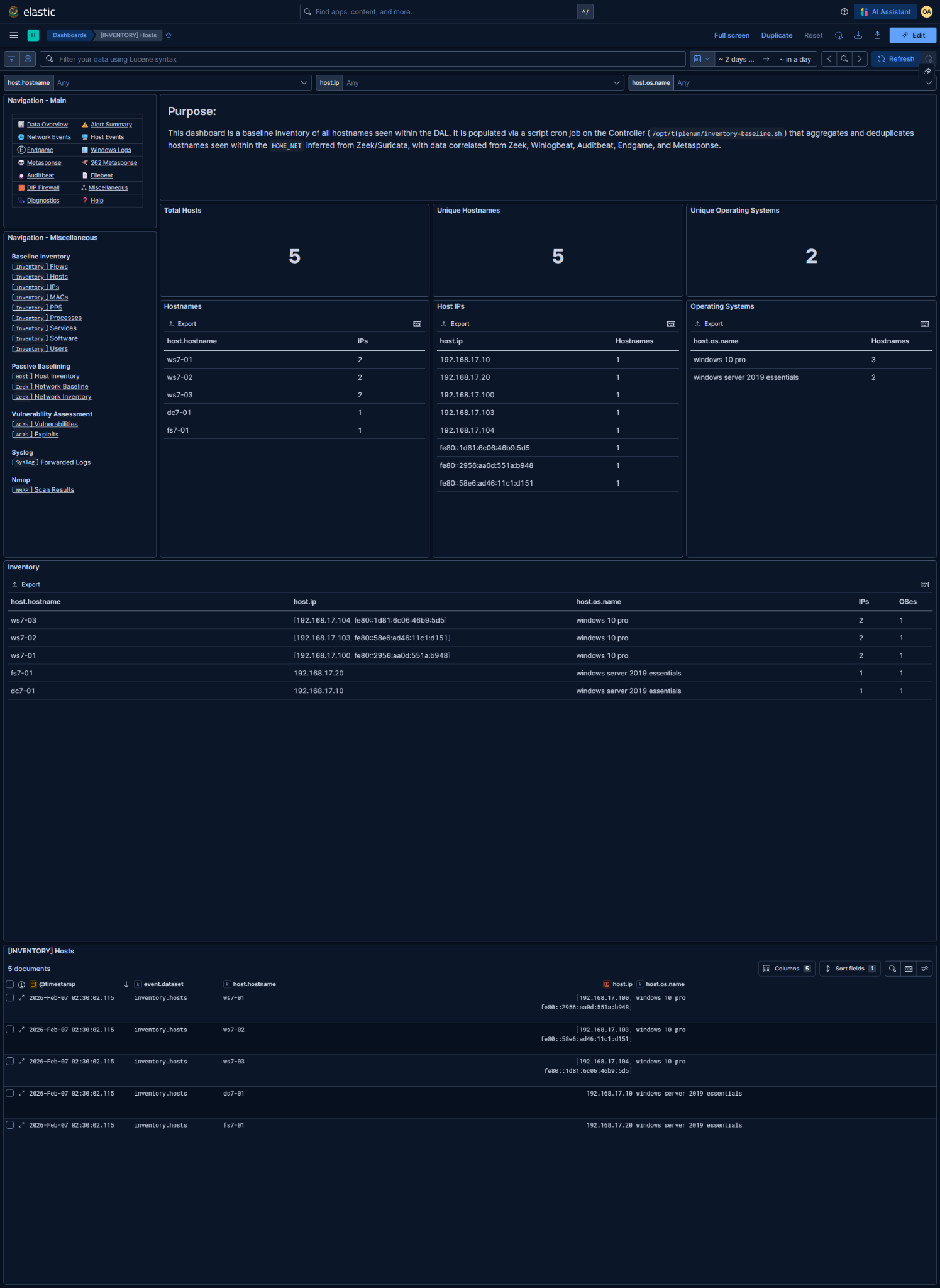
Kibana Dashboard: [INVENTORY] Hosts
What is this baseline?
The associated Kibana dashboard represents the baseline inventory of hostnames observed within the DAL.
- A host entry consists of:
host.hostname- One or more associated
host.ipvalues - One or more associated
host.os.namevalues (when available)
- Each row answers:
"Was this hostname observed in the baseline inventory?"
- This is not an asset management system:
- No guarantee the host is still online
- No lifecycle or state tracking
- No assurance the hostname is authoritative
- A single corroborated observation is enough to add a hostname to the baseline.
- Entries are deduplicated by hostname
- Hostnames are normalized (short name, lowercased)
- A hostname is added if it can be correlated to a DAL IP
@timestampreflect when the hostname was last observed
Data Prerequisites
If any of these are missing or incorrect, the baseline is unreliable.
1. DAL / HOME_NET must be correct
- Derived from Zeek and/or Suricata
HOME_NET - Used to determine which IPs are considered internal
- Hostnames are only inventoried when they correlate to DAL IPs
- Incorrect DAL → missing hosts or misattributed assets
2. Required telemetry sources (at least one)
- Zeek (
conn,dns,dhcp,ntlm) - Winlogbeat / Sysmon
- Auditbeat
- Endgame
- Metasponse (any collector)
NOTE: Hostnames are heavily dependent on correlation.
Sparse telemetry will result in partial or delayed hostname discovery.
Basic Analysis Workflow
1. Baseline sanity check
Start by validating expected inventory size and composition:
- Known hosts are present
- Hostnames align with mission topology
- OS distributions make sense (e.g., servers vs workstations)
- No obvious junk hostnames (e.g., random strings, malformed names)
Unexpected absences usually indicate missing telemetry, not stealth.
2. Long-tail analysis (primary value)
Focus on unaccounted hosts or unexpected hostnames
- Hostnames that don't follow standardized schemas
- Hosts with uncommon OS values
Key questions
- A transient system (jump host, installer, scanner)?
- A renamed system?
- An unauthorized or rogue device?
Validate against
- Mission documentation
- Asset lists
- Network diagrams
- Admin confirmation if required
3. IP and OS correlation review
Multiple IPs per hostname
- Normal for DHCP environments
- Suspicious if crossing security zones or VLANs
Multiple OS values per hostname
- Often indicates telemetry drift or reimaging
- Rarely benign if simultaneous
Both cases warrant clarification, not immediate escalation.
4. Export for reporting and diffing
Reporting and documentation requirements are determined by the Mission Element Lead/Crew Lead
Common exports
- Full Inventory table (CSV)
- Hostname + IP + OS mapping
NOTE: These exports represent the declared host baseline for the mission period.
5. Enable baseline deviation detection rule
Enabling too early guarantees noise - it will alert on ALL new inventory additions after enablement.
Detection rules can be managed in Kibana under Security → Rules
Rule: [262][Inventory] New hostname added to baseline
- Detection logic:
Alert when a new hostname within the DAL is added to the baseline inventory
- Only enable after:
- Baseline window is complete
- All expected hosts are observed
- Long-tail hostname review is finished
- Ongoing alert tuning:
- Whitelist known late-arriving assets
- Suppress ephemeral or mission-support systems
- Validate hostname legitimacy before escalation
This rule is intended to catch:
- Rogue hosts
- Unauthorized additions